
Rotating equipment reliability guide
Why a Brand New Pump Fails on Day One
Reader question: “Brand new pump already failed”
A pump that dies in its first hours almost never dies at random. Before blaming the factory — and before restarting the unit and destroying the evidence — work through the six first-day killers and build the record that keeps the warranty claim alive.
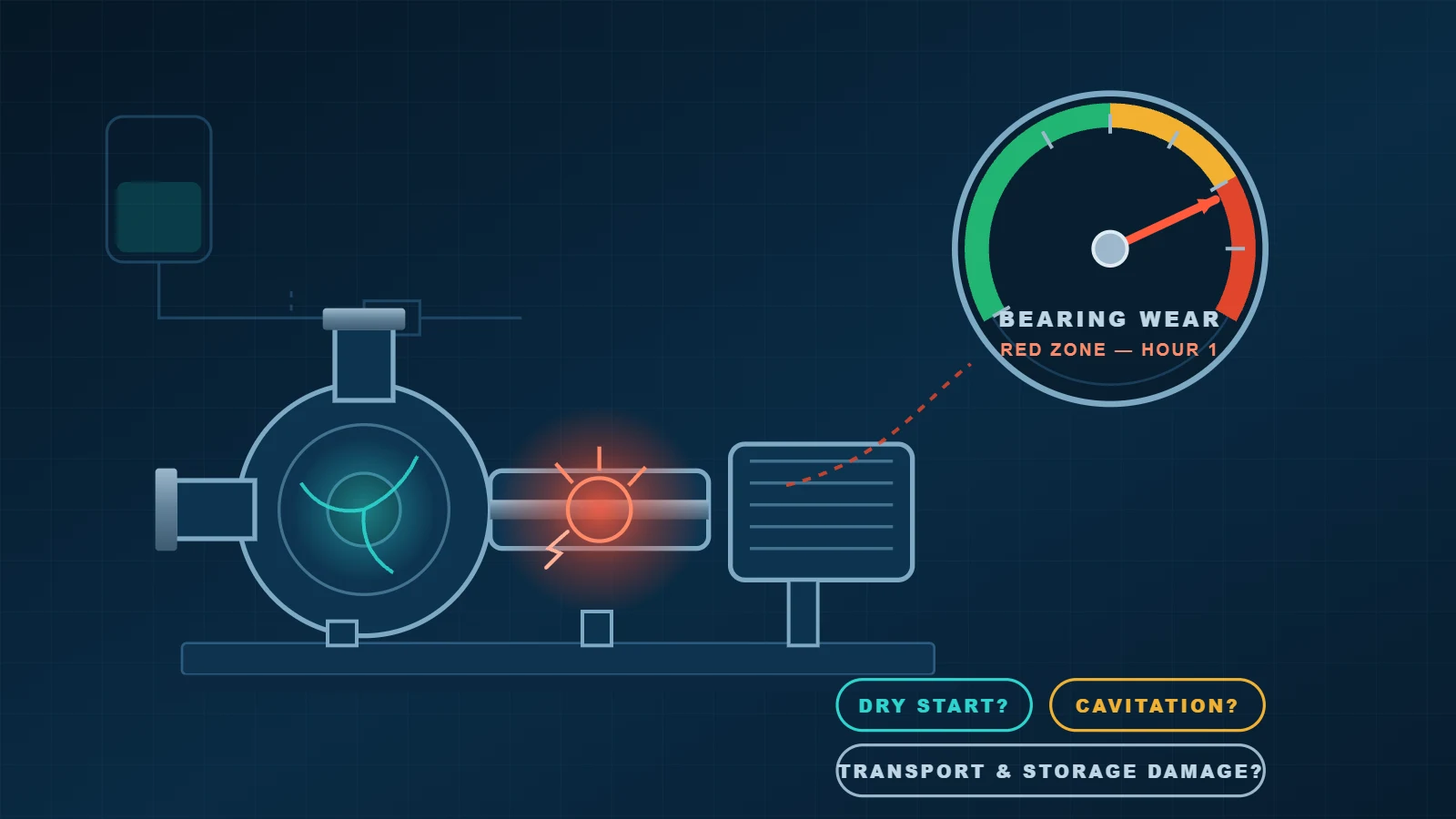
Failure triage
The six first-day killers
Reliability data says early failures concentrate in installation, commissioning and system causes — work through them in this order before opening the pump.
Dry or vapor-locked start
Product-lubricated bearings and seal faces are destroyed in seconds to minutes without liquid.
Starved suction
Blocked strainers, deposits or flashing liquid collapse the film that carries the rotor.
Transit and storage damage
Vibration while stationary frets the bearing raceways before the first start.
Pipe strain and misalignment
Forced flanges and uncorrected alignment load bearings far beyond design.
Air or gas entrainment
A few percent of gas cuts performance and shakes bearings and seals.
True factory defect
Real, but rarer — and only provable after the first five are ruled out with records.
Short answer: treat a day-one failure as a system event until proven otherwise. Stop the pump, preserve the evidence, and check the dry-start, suction, transport and installation paths before accepting either a repair bill or a denied warranty.
In the original Reddit report published on May 22, 2026, a brand-new canned motor pump on liquid ammonia service started up with its bearing-wear gauge already in the red and internals that sounded, in the poster's words, like gravel. Commenters immediately asked the two right questions: did operations dry-start it, and is there deposit build-up in the suction supply? This guide generalizes that triage for any new process pump.
What a Red Bearing-Wear Indicator Actually Tells You
Canned motor pumps carry no external mechanical seal; the pumped liquid itself lubricates the internal sleeve bearings. That is why manufacturers fit rotor-position monitors — for example, Teikoku equips its canned motor pumps as standard with the TRG device, which displays real-time radial bearing wear by measuring the induced voltage as the rotor-to-stator gap changes. See Teikoku Electric, product documentation.
A red reading is a position measurement, not an opinion. The rotor really is running off-center beyond the wear allowance. The monitor tells you that the bearing is gone — never why. The "why" usually lives outside the pump.
Why "Brand New" Does Not Mean "Cannot Fail"
| Reliability data point | Value | Source and date |
|---|---|---|
| Premature bearing failures caused by poor lubrication — including a liquid film that never formed | ~36% | SKF, accessed July 2026 |
| Premature bearing failures caused by improper mounting and handling | ~16% | Same SKF data set |
| Premature bearing failures caused by contamination | ~14% | Same SKF data set |
| Bearings that outlive the machine they are installed in | ~90% | SKF training data via Reliamag, accessed July 2026 |
| Rotating machinery failures attributed to shaft misalignment (coupled machines) | 30–50%+ | Plant Engineering, accessed July 2026 |
| Centrifugal pump MTBF spread across plants, attributed to specification, installation and operating discipline | ~3 to 10 years | Heinz Bloch's refinery data via Reliamag, accessed July 2026 |
The same pump model, from the same factory, can average three years between failures in one plant and ten in another. A failure at hour one sits at the extreme end of that installation-and-operation spectrum — which is exactly why the evidence matters more than the anger.
How to Confirm Each First-Day Killer
| Cause | Typical signature | How to confirm | Usual responsibility |
|---|---|---|---|
| Dry or vapor-locked start | Grinding within seconds; wear monitor moves immediately; seal faces heat-checked white on sealed pumps | Start log, venting and priming records, suction valve lineup at first start | Site operations |
| Cavitation / starved suction | Gravel or crackling noise, fluctuating discharge pressure, wear progressing over hours | NPSHA vs NPSHR; strainer contents; deposits in the suction line; tank level record | Site system design or operations |
| Transport and storage damage | Noise present from the very first rotation after long shipping or storage | Shipping and storage history; evenly spaced fretting marks on raceways (false brinelling). See American Roller Bearing, accessed July 2026 | Shared — packing spec vs storage practice |
| Pipe strain / misalignment | Vibration, hot coupled-end bearing; flanges that needed force to bolt up | Loosen flanges and re-check gaps; alignment record before and after piping | Site installation |
| Air or gas entrainment | Performance below curve with noise and vibration; 2% gas by volume cuts capacity ~10%, 4% up to 40%. See WaterWorld, accessed July 2026 | Vortexing at the source, suction-joint leaks, venting records | Site system or operations |
| True factory defect | Failure signature at zero hours with items above ruled out | Joint teardown against the factory test record for the serial number | OEM warranty |
For liquefied-gas duties such as ammonia, the liquid sits close to its vapor pressure. A small suction restriction, a warm liquid slug or a pressure dip at start is enough to flash the liquid — and a product-lubricated bearing loses its film the moment liquid turns to vapor. Deposits accumulating in the suction supply, raised by a commenter in the original thread, are a classic and provable starvation mechanism.
The 15-Minute Evidence Kit — Before You Call the OEM
One maintenance team in the thread reported that warranty claims on this pump type had been "impossible." Claims are won on documentation, not volume:
- Do not restart the pump. Additional red-zone minutes convert a defect claim into "operational damage."
- Photograph everything as found: wear-indicator reading, nameplate, installation, valve positions.
- Export the trend at failure: suction pressure, discharge pressure, flow, motor amps, liquid temperature.
- Record run hours and starts, including test bumps during commissioning.
- Pull and bag the suction strainer contents.
- Take a liquid sample from the suction line — solids, moisture, oil carry-over.
- Freeze the paper trail: shipping documents, storage duration and location, lifting method, first-start checklist, who vented and primed.
- Request the factory test record for your serial number and insist on a joint teardown — do not open the pump alone if you want the warranty to survive.
The Commissioning Checklist That Saves Pump #2
- Verify storage history; rotate stored rotors periodically so stationary vibration cannot fret the raceways (false brinelling).
- Flush and prove the suction line clean before final connection — construction debris kills day-one bearings.
- Bolt piping up stress-free; on coupled pumps, do final alignment after piping and record the numbers.
- Check rotation direction with the coupling opened before the first coupled start.
- Vent the casing and suction line completely; for liquefied gases, chill down and pressure-equalize per the OEM procedure.
- Confirm NPSH margin against the datasheet. Guidance commonly applied to chemical process duties from ANSI/HI 9.6.1 is an NPSHA/NPSHR ratio of 1.1–1.2, or 0.6–1.0 m of absolute margin — see the Michael Smith Engineers summary (accessed July 2026) and the Hydraulic Institute note on the 2024 edition (March 18, 2025), which restates margins against NPSHR.
- Establish minimum-flow protection before start; never start against a closed discharge without a rated bypass.
- Record a commissioning baseline: wear-monitor reading, vibration, amps and pressures. This is the warranty reference point.
Common Misconceptions
- "It's new, so it can't be the system." Lubrication loss, mounting and contamination — externally imposed causes — dominate premature bearing deaths in the SKF data above.
- "It passed the factory test, so it must work here." Factory tests run on a controlled test fluid with a clean suction. Your fluid, your venting practice and your suction line were not on the test bed.
- "The monitor is probably miscalibrated." Rotor-position monitors read a physical gap. Treat red as real until a joint inspection proves otherwise.
- "Run it and see if it improves." Bearing wear is not self-healing; continued running only voids the claim.
- "Warranty will sort it out." Warranty covers defects, not dry starts. Without the evidence kit, every early failure defaults to operational damage.
Replace in Kind, or Re-Select?
If the joint teardown lands on the first five causes, the same model will die the same way until the system is corrected — fix the suction, venting or installation first, then replace in kind. If the duty itself was mis-specified — flow far from BEP, NPSH margin inadequate by design, solids the pump was never rated for — re-selection is the cheaper path over five years even when warranty pays for the first repair. Our guide on repairing versus replacing an industrial process pump covers that decision in detail.
Where an ANSI Chemical Process Pump Fits
For sealed ANSI B73.1 chemical process duties, YSM supplies replacement pumps and wet-end parts for the G196 and D Mark III ANSI process-pump families. Our replacement-parts RFQ checklist asks for the data that prevents day-one failures — suction conditions, NPSH margin, liquid properties at temperature, and storage and transport requirements — before any selection is confirmed. If you are documenting an early failure right now, request the factory performance test documentation together with the replacement quote: it becomes the baseline for your next commissioning. If the failure involved a leaking or heat-checked seal, start from the mechanical seal failure root cause checklist.
TRG is a product designation of Teikoku Electric Mfg. Co., Ltd. YSM is an independent manufacturer and is not affiliated with, or endorsed by, Teikoku Electric. Model references identify compatibility only.
Sources and Dates
- Original Reddit report — May 22, 2026
- SKF: premature bearing failure causes — accessed July 2026
- Reliamag: pump MTBF statistics compiling Heinz Bloch's data — accessed July 2026
- Plant Engineering: shaft misalignment in rotating machinery — accessed July 2026
- Teikoku Electric: TRG bearing-wear monitor — accessed July 2026
- WaterWorld: air and cavitation effects on pump performance — accessed July 2026
- American Roller Bearing: false brinelling — accessed July 2026
- Michael Smith Engineers: NPSH margins per ANSI/HI 9.6.1 — accessed July 2026
- Hydraulic Institute: 2024 updates to ANSI/HI 9.6.1 — March 18, 2025
Related Technical Guides
Repair or Replace an Industrial Process Pump?
Decide between repairing the failed unit and re-selecting for the duty, with lifecycle cost logic.
Read the decision guideUrgent ANSI Pump Replacement Parts RFQ Checklist
Collect the nameplate, dimensional and duty evidence that makes an urgent parts quote accurate.
Open the RFQ checklistDocumenting an Early Pump Failure?
Send the nameplate, run hours, operating trend at failure, suction layout and storage history. We will review the duty against the ANSI process-pump families and flag what belongs in the warranty file.