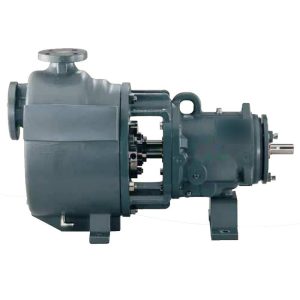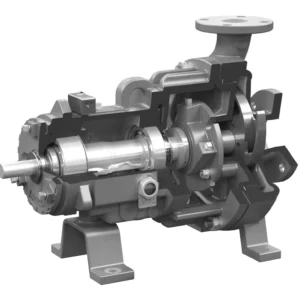


D Mark III Series · Low Flow
The D Mark III Low Flow model is the dedicated LF branch of the ANSI/ASME B73.1 reverse-vane pump family, for duty points below the practical range of a general-purpose selection. Current dimensional source data identifies LF sizes in Group 1 and Group 2; final suitability requires the duty point, system conditions and an approved pump curve — never a series envelope read as a guarantee.
The D Mark III Low Flow in the YSM Pump Programme
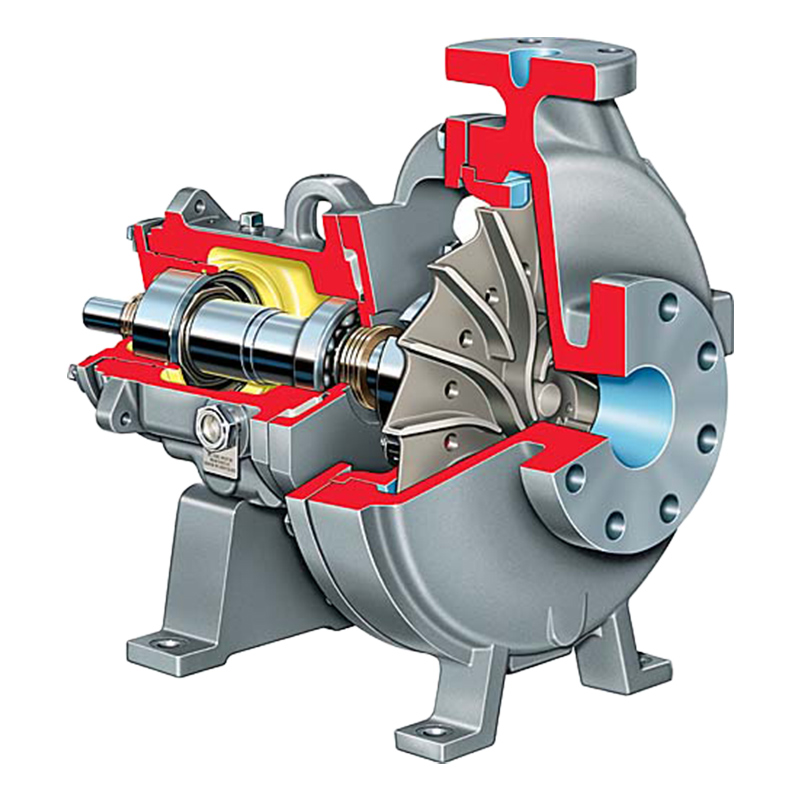
A centrifugal pump runs where the pump curve and system curve intersect. When that point sits far left of a general-purpose size’s best-efficiency region, the pump still runs — but with suction recirculation, higher radial loads, vibration and a hotter seal environment that shorten seal and bearing life. The dedicated LF sizes exist to remove that trade, and on the reverse-vane platform they carry the family’s back-side impeller behaviour — pump-out vanes and external adjustment at the rear cover — into small-capacity service.
General Purpose
D Mark III General Purpose Pump
For duty points within the broader general-purpose range — the reverse-vane family default, with the published envelope, Group coverage, installation drawings and exploded parts view on its page.
View the D Mark III General Purpose pumpSeries context
D Mark III Series ANSI Chemical Process Pumps
The family page carries the full per-group size list — including the LF entries — the performance coverage curves and the seal-chamber guidance.
Explore the D Mark III SeriesQuick Selection Summary
| Standard | ANSI/ASME B73.1 family | Impeller family | Reverse vane; external adjustment |
|---|---|---|---|
| Confirmed LF groups | Group 1 and Group 2 | Confirmed LF entries | 1K 1.5×1LF-4, 1K 1.5×1LF-8, 2K 2×1LF-10, 2K 3×1.5LF-13 |
| Seal chambers | CBS, CBL, FMS, FML family options | Selection basis | Duty point and approved curve |
No independent LF performance range is present in the knowledge base. D Mark III series maximums are not guarantees for these LF sizes.
Confirmed LF Size Coverage
LF size codes follow the family convention — suction × discharge − nominal impeller diameter, with the LF tag marking the dedicated low-flow hydraulic and the Group prefix (1K, 2K) fixing the power end. Four entries are confirmed in the current source; the Group 3 row states the boundary rather than hiding it.
| Group | LF entries in current source | Status |
|---|---|---|
| Group 1 / 1K | 1K 1.5×1LF-4; 1K 1.5×1LF-8 | Dimensions and replacement-part entries represented |
| Group 2 / 2K | 2K 2×1LF-10; 2K 3×1.5LF-13 | Dimensions and replacement-part entries represented |
| Group 3 / 3K | No independent LF entry confirmed | Do not infer availability |
Send the group, LF size and existing reference before requesting a drawing or replacement component — the Replacement Parts Center carries the family’s parts coverage, materials and ordering steps.
Where the Low-Flow Review Starts
The recurring situations behind reverse-vane LF enquiries, each linked to the guide that prepares a reviewed enquiry for it.
Dedicated low-flow process duties
Small-capacity dosing, transfer and circulation services where the normal flow sits below the practical range of the smallest general-purpose sizes — with the reverse-vane seal-chamber behaviour carried into small service. Low-flow application guide →
Operating-point and system-curve review
Duties where the honest first question is where the pump will actually run — system curve, BEP position and control method decide whether an LF size or a general-purpose size serves the duty. System curve, BEP and low-flow guide →
Replacement of installed LF sizes
Parts and like-for-like review for LF pumps already in service, from the group, LF size and existing reference. Maintenance & replacement guide →
Design, Seal and Materials
The LF model uses the D Mark III family design context: reverse-vane impeller, external adjustment, Group-based power ends, CBS/CBL/FMS/FML seal-chamber families, SKF or equivalent bearings and labyrinth isolators. Low-flow service makes the seal environment matter more, not less — at small flows the chamber’s volume and circulation carry more of the heat-management burden — so the chamber is confirmed together with the sealing plan. Published wet-end materials may include WCB, CF8M/316SS, CD4MCu, CN7M/Alloy 20, Nickel, Hastelloy, Titanium and selected zirconium-alloy scope.
Material and seal configuration require the complete liquid, concentration, temperature, pressure, solids and leakage requirements — the material input checklist prepares that review.
Curves, Dimensions and Parts Review
Final low-flow selection remains pending an approved curve — an LF selection issued without its curve would be exactly the guess this page exists to prevent. Send the group, LF size, duty point and any model, reference, drawing or nameplate photo for the correct dimensional or parts review. Pump down or planning maintenance? The urgent parts RFQ checklist collects everything in one request.
Interchange guides: D Mark III vs Durco Mark 3 — what is interchangeable and what is YSM’s own design · replacement routes and interchange checks compared.
D Mark III Low Flow FAQ
What duty data is required?
Send minimum, normal and maximum flow, head, system curve, liquid properties, temperature, solids, suction conditions, schedule and motor supply. The complete operating range matters more than the nominal flow — it decides whether the duty sits inside an LF size’s practical range.
Can the family maximums be used for the LF sizes?
No. Use the approved curve and size-specific configuration limits — no independent LF performance range is present in the knowledge base, so the curve review is the selection.
Why not throttle a general-purpose pump into a low-flow duty?
It will run, but far left of best efficiency: suction recirculation, higher radial loads, vibration and a hotter seal environment shorten seal and bearing life. That trade is why the dedicated LF sizes exist. If the normal flow sits well below the general-purpose coverage, start here instead.
How does an LF size code like 2×1LF-10 read?
Suction × discharge − nominal impeller diameter, in inches, with the LF tag marking the dedicated low-flow hydraulic: 2-inch suction, 1-inch discharge, nominal 10-inch class. The Group prefix (1K, 2K) fixes the power end — confirm the exact designation during review. Both size-code conventions are explained in ANSI pump size codes.
Is a Group 3 LF size available?
The current source does not confirm one. Availability must not be inferred without technical documentation — the coverage table states the boundary deliberately.
How are materials and seals confirmed?
They are selected from the complete liquid and operating data, not from a generic application label. At low flow the seal environment carries more of the heat-management burden, so the CBS/CBL/FMS/FML chamber and the sealing plan are confirmed as one decision.
Can you supply replacement parts for installed LF pumps?
Yes — the confirmed LF entries are held with dimensions and replacement-part entries, and the Replacement Parts Center carries the family’s wider coverage, materials and ordering steps. For obsolete or undocumented parts, the reverse-engineering path works from a drawing, sample or dimensioned photographs.
Are OEM or branded (ODM) orders supported?
Yes — OEM and ODM programmes are part of the standard offer (see About YSM Pumps). Branding, documentation and packaging requirements enter the same technical-commercial review as the pump itself; state them in the enquiry rather than after order.
How is pricing confirmed?
Quotations are issued against a reviewed selection — Group and LF size, materials, sealing, scope and quantity — confirmed on the approved curve, not against a model name alone, which is why no public price list exists. Send the complete operating range and requirements; the quotation then references the size-specific configuration it prices.
What are the lead time and warranty for this pump?
Typical lead time is 4 weeks for a complete pump, 2 weeks for a bare wet end and 1 week for replacement parts, from deposit and approved drawings. Warranty is 12 months from shipment against defects in materials and workmanship within the reviewed duty. Late shipment attributable to YSM is compensated at 0.5% of contract value per week, capped at 5%.
What are the payment and delivery terms?
30% T/T deposit within 7 days of order, 70% T/T before shipment, or irrevocable L/C at sight; export-grade wooden-case packing; any Incoterms 2020 term (EXW Zibo, FOB Qingdao, CIF, DAP/DDP) as agreed in the quotation. Factory witness testing and third-party inspection (SGS, BV, TÜV) are accepted. Full terms: Commercial Terms
Request a D Mark III Low-Flow Quote
The form below carries the initial request; drawings, nameplate photos and any remaining data can follow during review. The technical review uses, where available: the complete operating range — minimum, normal and maximum flow with required head, not only the nominal point — plus the system curve and control method, liquid composition, concentration, temperature, viscosity, solids, suction/NPSH conditions, operating schedule, seal-chamber and material preferences, motor voltage and frequency, quantity, documentation needs, destination and target delivery date. For replacement work, add the Group, LF size, existing reference and a nameplate photo.
Open “Add technical details” to fill in what you know, and mark anything uncertain as unknown — a marked gap is reviewable, a silent one is not.
Pump RFQ
Replied by the technical team with the curve-confirmed configuration and quotation scope.
D Mark III LF Review Workflow
- Send minimum, normal and maximum flow with required head.
- Confirm liquid composition, concentration, temperature, viscosity and solids.
- Review Group 1 or Group 2 LF size coverage against the approved curve.
- Confirm seal chamber, wetted materials, motor supply and documentation needs.
Start with this page when
- Flow lies below the usable range of a general-purpose selection and needs a dedicated hydraulic review.
- Reverse-vane family architecture is preferred for the service.
- An installed LF size needs parts or a like-for-like review.
Review another page when
- The duty sits within the general-purpose range: start from the D Mark III General Purpose page.
- An open-impeller low-flow configuration is preferred: review the G196 Low Flow page.
- The wider family is the question: compare on the D Mark III Series page.
Low-Flow Selection Path
Review the low-flow process pump application guide and the complete duty-data checklist before requesting a curve.
Operating-Point Review
Use the system curve, BEP and low-flow guide to define the required curve and operating range.