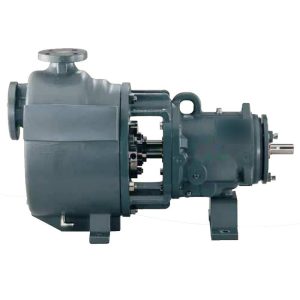
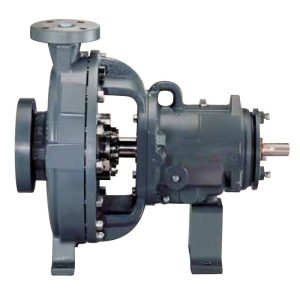
D Mark III Series · General Purpose
The D Mark III is an ANSI/ASME B73.1 reverse-vane chemical process pump for general industrial duties, organised into Group 1, 2 and 3 size ranges with external impeller adjustment and CBS, CBL, FMS or FML seal-chamber options. This page carries the model-level record — the published series envelope, Group coverage, materials, installation drawings and the exploded parts view — and the selection itself is confirmed against a reviewed, size-specific curve.
Series-level maximums for the general-purpose sizes; working pressure to 27 bar (400 psi), temperature from -73 °C (-100 °F). Individual size, impeller diameter, material and seal arrangement set the limits for a given pump, confirmed on the reviewed, size-specific curve.
The D Mark III General Purpose in the YSM Pump Programme
The general-purpose model is the reverse-vane family’s default: the configuration reviewed first when a B73.1 reverse-vane pump is the starting point and no special hydraulic constraint applies. It shares the Group 1/2/3 power-end logic, the wet-end parts coverage and the review discipline of the wider programme — what separates it from its low-flow sibling is the duty point it is designed to sit on, because a centrifugal pump runs where the pump curve and system curve intersect, not where the catalogue ends.
Series context
D Mark III Series ANSI Chemical Process Pumps
The family page carries the full per-group size list, the performance coverage curves and the seal-chamber guidance. Start there for family-level orientation; start here to configure a general-purpose selection.
View the D Mark III SeriesLow Flow
D Mark III Low Flow Process Pump
Dedicated LF sizes for duty points where a general-purpose selection would operate far left of best efficiency — throttling a larger pump into a small duty invites suction recirculation, vibration and a hotter seal environment. If the normal flow is specifically low, start from the low-flow page instead.
View the D Mark III Low Flow pumpQuick Selection Summary
The envelope below matches the series-level published range on the D Mark III Series page; it frames what the family can reach, and the reviewed, size-specific curve decides what a given pump will do.
| Standard | ANSI/ASME B73.1 | Impeller | Reverse vane (standard), external adjustment; open impeller for part of the size range |
|---|---|---|---|
| Groups | Group 1, 2 and 3 | Seal chambers | CBS, CBL, FMS, FML |
| Series flow/head | Up to 1700 m³/h / 300 m | Series pressure/temp. | Up to 27 bar / -73°C to 370°C |
Series maximums are not guaranteed for every group or size. Final limits require a selected size and configuration.
Design, Seal and Bearing Features
Each feature is stated with the consequence a buyer should attach to it — a B73.1 pump is specified for its behaviour in service, not for a list of nouns.
Reverse-vane wet end
The pumping vanes face the rear cover plate, and pump-out vanes on the back shroud sweep solids and pressure away from the seal chamber. Impeller clearance is set toward the back cover by external adjustment, so head and efficiency are recovered in place as wear opens the clearance — without a wet-end strip-down. Open impellers are available for part of the size range, confirmed per size during review.
Seal-chamber families
CBS, CBL, FMS and FML configurations, selected from service and seal requirements; FMI-type chambers and jacketed rear covers are not offered. The chamber is the mechanical seal’s operating environment — volume, circulation and solids behaviour at the faces — so it is confirmed together with the sealing plan, not after it.
Power end
SKF or equivalent bearings, labyrinth isolators and multiple shaft/sleeve combinations. The Group fixes shaft, bearing and housing scope — exactly the spare-parts scope a maintenance department standardises on — and the bearing arrangement is conventional, sourceable through normal industrial channels.
Where the D Mark III General Purpose Runs
The recurring duty patterns behind general-purpose reverse-vane enquiries, each linked to the guide that prepares a reviewed enquiry for it.
General chemical liquid transfer
Corrosive transfer, unloading and circulation duties across the process industries — the model’s home ground, with the back-side impeller behaviour earning its keep on light solids and demanding seal environments. Chemical liquid transfer guide →
Pulp & paper auxiliary services
Liquor, filtrate and chemical duties around the stock line; heavy stock itself belongs to the G 3175 / 3180 / 3185 review. Pulp and paper pumps guide →
Wastewater chemical transfer
Dosing and corrosive effluent duties in treatment plants — with the boundary checklist for when a solids-handling pump is the honest answer. Wastewater transfer guide →
Maintenance and replacement of installed B73.1 pumps
Wet-end, power-end and part-level replacement paths for existing installations, reviewed from nameplate evidence. Maintenance & replacement guide →
Group and Size Coverage
D Mark III size codes read suction × discharge − nominal maximum impeller diameter, in inches: a 3×2-13 takes suction at 3 in, discharges through 2 in and carries a nominal 13-inch impeller. The Group prefix (1K, 2K, 3K) fixes the power end, so a size choice is simultaneously a Group choice, with everything that implies for spares and envelope. Read the table as coverage, not commitment: adjacent sizes can both reach a duty point on paper, and only the reviewed, size-specific curve shows which one runs nearer best efficiency.
| Group | General-purpose source coverage |
|---|---|
| Group 1 / 1K | 6 and 8 inch-class ANSI entries, plus related small-size configurations |
| Group 2 / 2K | 8, 10 and 13 inch-class ANSI entries |
| Group 3 / 3K | 14, 16 and 17 inch-class ANSI entries |
See the full per-group size list and LF coverage on the series page.
Materials of Construction
Published YSM wet-end materials may include WCB, CF8M/316SS, CF3M/316L, CD4MCu, super duplex stainless steel, CN7M/Alloy 20, Nickel, Inconel, Hastelloy, Titanium and Zirconium alloy. Availability varies by component, group and size — which is why the material conversation starts from the service, not from the alloy list. The same acid name can be pumped in steel at one strength and demand an exotic alloy at another.
Confirm chemical composition, concentration, temperature, pressure, impurities, solids and corrosion conditions before material selection — the material input checklist prepares that review.
Installation Dimensions
Reference installation dimensions for the D Mark III on its baseplate: CP, X, D and the H-series letters locate the pump-and-driver set, HE, HA and the hole patterns carry the mounting interface. Confirm against a certified drawing for your specific size and configuration before construction.
Click a drawing to enlarge.Tap a drawing to open the full-resolution file.


Sectional Drawing & Parts List
YSM manufactures the complete D Mark III wet end and power end. Find the part on the exploded view, read its position number, and send that number with a nameplate photo for a reviewed quotation — the Replacement Parts Center carries coverage, materials and ordering steps.
Click the drawing to enlarge.Tap the drawing to open the full-resolution file.

The sheet is also held as a print-ready PDF — D Mark III Sectional Drawing & Parts List — Rev. A — collected with the rest of the published record on the technical downloads page.
Dimensions, Drawings and Replacement Parts
Parts coverage includes casing, impeller, shaft, cover plate, adapter, bearing housing, foot, seal/packing components and bearing-carrier parts. Submit the group, size and reference before requesting a dimensional drawing or parts match. Pump down or planning maintenance? A nameplate photo and a short description of the failed parts is the fastest route — the urgent parts RFQ checklist collects everything in one request.
Interchange guides: D Mark III vs Durco Mark 3 — what is interchangeable and what is YSM’s own design · replacement routes and interchange checks compared.
D Mark III General Purpose FAQ
What information is needed for selection?
Provide flow, head, liquid composition, concentration, specific gravity, viscosity, temperature, solids, suction conditions, operating schedule and motor supply. The duty point and the liquid decide everything downstream — Group, size, materials, seal environment and the curve the selection is confirmed on.
Do all groups share the same operating limits?
No. Published values describe the family envelope; actual limits depend on group, size, speed, material and seal configuration, confirmed on the reviewed, size-specific curve.
How does a size code like 3×2-13 read?
Suction × discharge − nominal maximum impeller diameter, in inches: 3-inch suction, 2-inch discharge, nominal 13-inch impeller. A Group prefix (1K, 2K, 3K) fixes the power end, and letter suffixes denote configuration variants — confirm the exact designation during review. Conversion to Goulds-pattern strings is in ANSI pump size codes.
What is a reverse-vane impeller, and why does it matter?
The pumping vanes face the rear cover plate rather than the front casing, and pump-out vanes on the back shroud move solids and pressure away from the seal chamber. Clearance is set toward the back cover by external adjustment, so performance is recovered in place as wear opens the clearance. For services with light solids or a demanding seal environment, that back-side behaviour is the reason to start from the reverse-vane family.
How is the seal chamber selected?
Selection among CBS, CBL, FMS and FML depends on the seal arrangement and complete service conditions — liquid, solids, pressure, temperature and site requirements. The chamber is the seal’s operating environment, so both are reviewed as one decision.
Can wetted material be chosen from the liquid name alone?
No. Concentration, temperature, impurities, pressure and corrosion conditions must be reviewed before confirming wetted materials — availability also varies by component, group and size, so send the liquid data rather than an alloy name.
Can an existing part number be reviewed?
Yes. Send the group, size, number, nameplate, drawing or sample details for technical and commercial review — a reference number alone is not treated as a fit conclusion.
Can you supply replacement parts for an installed pump of this pattern?
Yes — the complete wet end and power end are manufactured in house, and the Replacement Parts Center carries coverage, materials and ordering steps. For obsolete or undocumented parts, the reverse-engineering path works from a drawing, sample or dimensioned photographs.
Are OEM or branded (ODM) orders supported?
Yes — OEM and ODM programmes are part of the standard offer (see About YSM Pumps). Branding, documentation and packaging requirements enter the same technical-commercial review as the pump itself; state them in the enquiry rather than after order.
How is pricing confirmed?
Quotations are issued against a reviewed selection — Group and size, materials, sealing, scope and quantity — not against a model name alone, which is why no public price list exists for the family. Send the duty data and requirements; the quotation then references the size-specific configuration it prices.
What are the lead time and warranty for this pump?
Typical lead time is 4 weeks for a complete pump, 2 weeks for a bare wet end and 1 week for replacement parts, from deposit and approved drawings. Warranty is 12 months from shipment against defects in materials and workmanship within the reviewed duty. Late shipment attributable to YSM is compensated at 0.5% of contract value per week, capped at 5%.
What are the payment and delivery terms?
30% T/T deposit within 7 days of order, 70% T/T before shipment, or irrevocable L/C at sight; export-grade wooden-case packing; any Incoterms 2020 term (EXW Zibo, FOB Qingdao, CIF, DAP/DDP) as agreed in the quotation. Factory witness testing and third-party inspection (SGS, BV, TÜV) are accepted, and a dimensional inspection report can be issued with the order. Full terms: Commercial Terms