
Mechanical seal contamination control guide
Seal Wear Particles in the Product: What Pharma Service Actually Requires
Reader question: “Is it typically acceptable practice in pharma world to use white materials in their seals so they don't show up?”
No — hiding wear particles fails the audit that finding them would have passed. What regulated plants actually do: compliant materials chosen for the duty, wear-rate-based seal replacement, and elastomers engineered to be more detectable, not less.
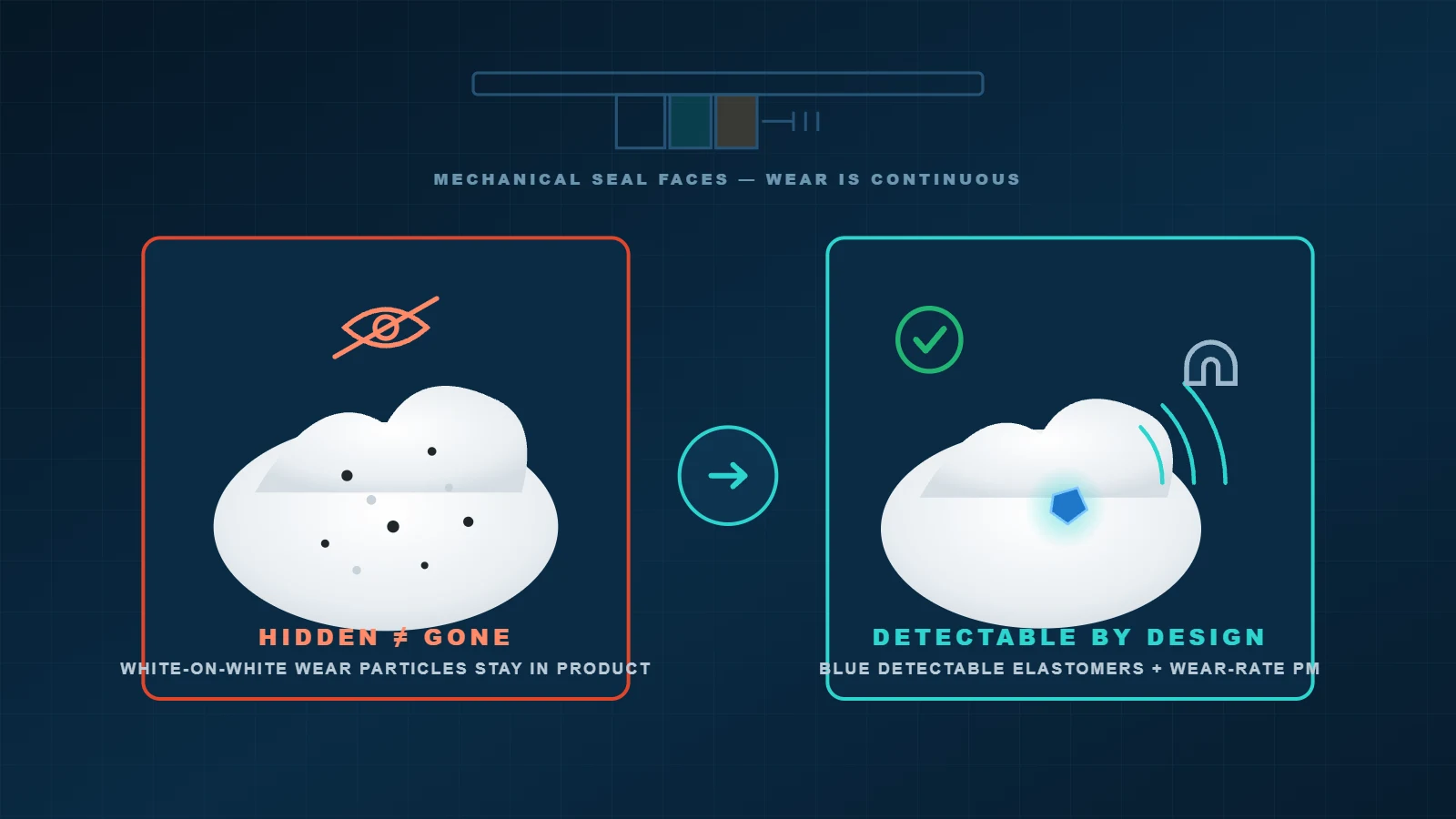
Two strategies
Hiding particles versus controlling them
The same speck event can end in a repeat failure or a scheduled maintenance line item. The difference is which column the plant works from.
Camouflage — fails the audit
- White seal materials chosen to make wear invisible
- Particles remain in product; complaints and retained samples still find them
- Root cause stays open; wear rate stays unknown
- OOS investigation closes without a defensible CAPA
FIND
Control — passes the audit
- Face pair and elastomer selected for the duty and compliance
- Preventive replacement set from the measured wear rate
- Flush or dual-seal architecture keeps debris out of product
- Detectable blue elastomers make escapes findable in-line
Short answer: no. Changing seal materials to a color that hides wear particles does not remove the contamination — it removes your ability to see it, and regulators treat that as an unaddressed root cause. The accepted playbook is compliant materials selected for the duty, wear-rate-based preventive replacement, seal arrangements that keep debris out of the product, and a detectability strategy.
In the original Reddit question published on June 9, 2026, a plant producing a food- and cosmetic-grade white powder was failing drums over black specks traced to seal wear, and asked whether specifying white seal materials "so they don't show up" is accepted practice. The top-voted answer — understand the wear rate and replace proactively — is also the regulator-aligned one. Here is why, and how to implement it.
Why Black Specks Appear in White Product
Mechanical seal faces are designed to wear. In the most common face pair, a carbon-graphite primary ring runs against a harder counterface, and the microscopic fluid film between the faces cannot prevent gradual loss of carbon over the seal's life. That carbon leaves as fine dark particles. In most liquid services they disperse unseen; in a white powder or high-value formulation they surface as black specks — and every speck event costs a drum, a batch or an investigation. The plant in the thread was not seeing something unusual: a normal wear mechanism was landing in an unusually unforgiving product.
Why "Make It White" Fails the Regulatory Test
- Foreign matter is defined by presence, not visibility. Particles you can no longer see are still in the product, still subject to complaints, retained-sample review and audit. As one commenter put it: not seeing them does not mean they are not affecting quality.
- Contamination findings require root-cause CAPA. The U.S. FDA's revised guidance on investigating out-of-specification results (CDER, Level 2 revision, May 16, 2022) formalizes a two-phase investigation — laboratory first, then manufacturing — ending in an identified root cause and corrective action. "We changed the contaminant's color" does not survive that framework. See the FDA guidance and the Outsourced Pharma summary, 2022.
- Industry uses color in the opposite direction. Food and pharma plants deliberately specify blue elastomers because blue is rare in natural products and easy to spot — and detectable grades embed metal- and X-ray-detectable additives so fragments smaller than 1 mm can be caught by in-line inspection. See J-Flex and Detectamet, accessed July 2026.
One nuance keeps this fair: white FDA-compliant elastomers (for example, white EPDM or silicone meeting FDA 21 CFR 177.2600) are legitimate, widely used materials chosen for compliance and cleanability — see Advanced Seals, accessed July 2026. Using a compliant white material is fine. Using color choice as the corrective action for a contamination finding is not.
Select Face Materials for the Duty, Not the Color
| Face pair | Wear-debris source | Abrasive resistance | Typical use | Trade-off |
|---|---|---|---|---|
| Carbon vs. silicon carbide (SiC) | Carbon ring — dark particles | Moderate | Default pair for clean liquids | Debris is dark and visible in light product |
| SiC vs. SiC | Minimal — both faces very hard | High | Abrasive, crystallizing or particle-laden duties | Less forgiving of dry running; needs engineering review |
| Tungsten carbide vs. SiC | Minimal | High | Slurries and harsh duties | Cost and weight |
Moving from carbon/SiC to a hard/hard pair removes the largest dark-particle source. That is a material fix, not a cosmetic one — but it tightens the seal's tolerance of off-design running, so treat it as a reviewed engineering change, never a store-room substitution.
Set the Replacement Interval From the Wear Rate
Seal-related work already represents roughly 60–70% of centrifugal pump maintenance in refinery reliability surveys compiled by Heinz Bloch — see Reliamag, accessed July 2026. Planning that work beats reacting to it:
- Record the installation date and duty of every seal in product-contact service.
- When specks first appear, note the elapsed run time. That is the speck-generation life for this duty.
- Inspect the removed seal and measure face wear against the manufacturer's allowance.
- Set the preventive interval at roughly 50–70% of the speck-generation life. One plant practice cited in the thread: change six months before specks historically appear.
- Trend every replacement. Wear rates drift when duty, CIP chemistry or flush conditions change — a shortening life is an early process alarm, not an inconvenience.
Keep Wear Debris Out of the Product Path
- Flushed single seals: a clean external flush of the seal chamber (API Plan 32 type) carries debris away from the product side.
- Double seals with barrier fluid (Plan 53/54 type): the product never touches the atmospheric-side faces, and wear debris stays in the barrier system.
- Quench and containment arrangements for powders and crystallizing media, so faces never run on dried product.
Which arrangement fits depends on the pump's seal chamber and the process. The point is that seal architecture is a contamination control, not only a leakage control. Our mechanical seal failure root cause checklist covers the failure-side evidence, and the material selection guide lists the duty data that decides between face pairs.
Common Misconceptions
- "White compliant material = problem solved." Compliance governs what the material may touch; it says nothing about how much of it is flaking into product.
- "Specks are cosmetic." They are foreign matter with full investigation obligations, whatever their color.
- "If the customer can't see it, there's no risk." Complaints are one detection path; audits, retained samples and in-line inspection are the others.
- "A white store-room seal is a quick CAPA." An investigation that closes without addressing the actual root cause is a standard inspection finding — see Cloudtheapp's OOS guide, accessed July 2026.
- "Hard/hard faces fix everything." They remove the carbon debris source but tolerate less dry running and off-BEP operation. Pair the change with operating discipline.
Where This Lands for Industrial Chemical Duties
The same logic scales from pharma to any plant where product purity pays the bills: know the seal wear rate, replace on schedule, choose face materials for the duty, and keep documentation that survives an audit. For ANSI B73.1 chemical process pumps, YSM supplies wet-end and seal-chamber replacement parts for the G196 and D Mark III ANSI process-pump families, with material documentation available on request through the replacement parts program. Our RFQ asks for the product-contact and duty details — media, temperature, CIP chemistry, abrasives — that decide between carbon and hard-face pairs before we quote. If your plant is fighting speck events today, start the wear-rate log above this week: it is the cheapest contamination control you will ever install.
Sources and Dates
- Original Reddit question — June 9, 2026
- FDA (CDER): Investigating Out-of-Specification (OOS) Test Results for Pharmaceutical Production — Level 2 revision, May 16, 2022
- Outsourced Pharma: FDA updates OOS guidance — 2022
- Cloudtheapp: how to conduct an OOS investigation — accessed July 2026
- J-Flex: metal-detectable food-safe rubber, fragments under 1 mm detectable in-line — accessed July 2026
- Detectamet: metal-detectable and X-ray-visible seals and gaskets — accessed July 2026
- Advanced Seals & Gaskets: FDA 21 CFR 177.2600 detectable silicone — accessed July 2026
- Reliamag: seal work as ~60–70% of pump maintenance, per Heinz Bloch's data — accessed July 2026
Related Technical Guides
Mechanical Seal Failure Root Cause Checklist
Work from leak location and timing to the failure mechanism before ordering the next seal.
Read the root-cause checklistChemical Pump Material Selection: Data to Confirm First
Collect the media, concentration and temperature evidence that materials decisions depend on.
Open the materials guideHow to Replace Mechanical Seals
Plan the replacement, run the checks before fitting and set the seal correctly.
Read the replacement guideFighting Speck Events in a Clean Product?
Send the seal type, face materials, elastomer grades, duty conditions and CIP chemistry, plus the interval between seal installation and first specks. We will review the material pair and the replacement interval logic.