
Viscous-flow engineering guide
High-Viscosity Pumping: Laminar-Flow References and How to Use Them
Reader question: “Is there any good references out there for fluid mechanics on high viscosity and laminar fluids?”
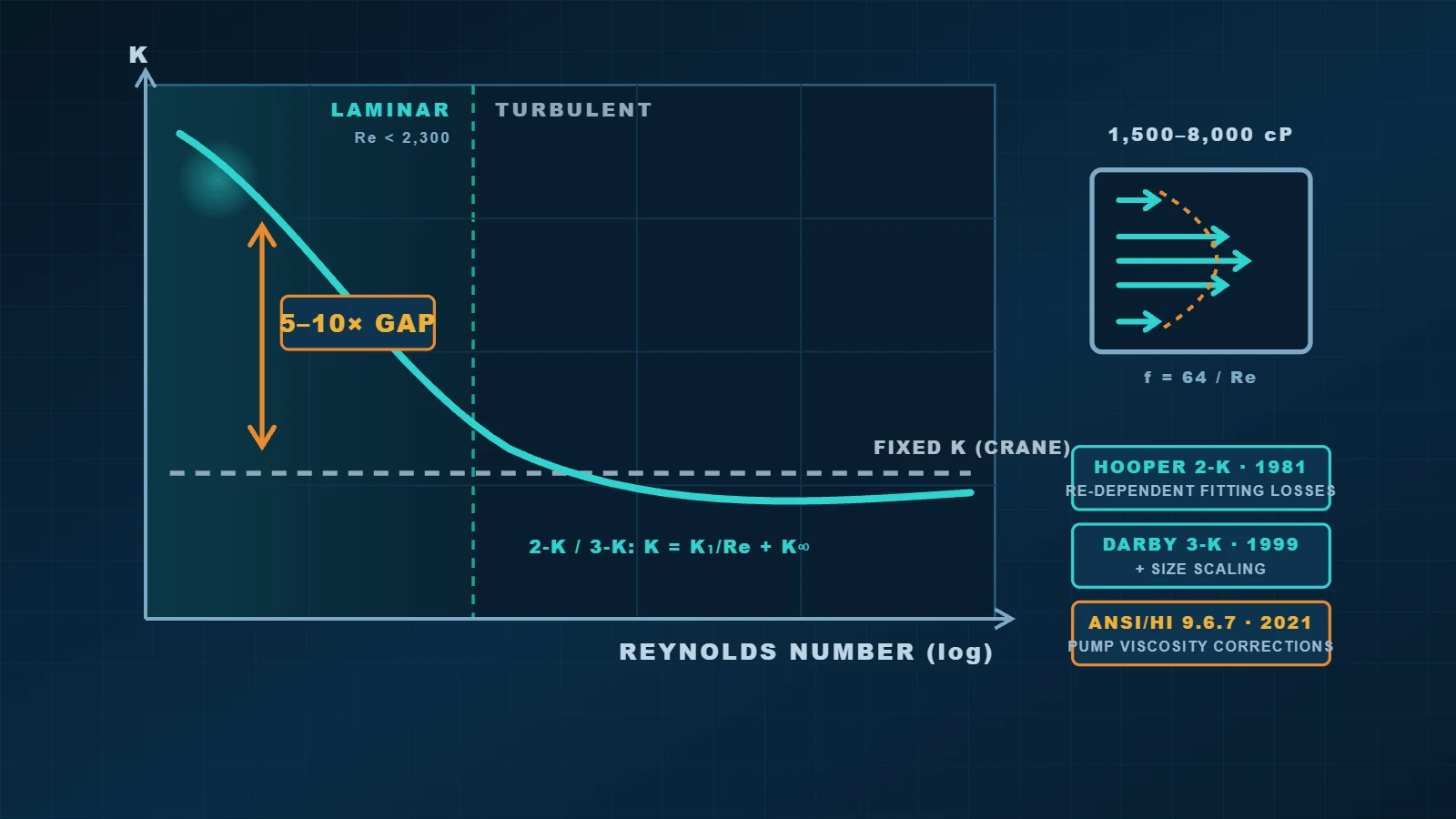
Yes, and they are specific: Hooper's 2-K and Darby's 3-K correlations for laminar fitting losses, and ANSI/HI 9.6.7 for pump performance on viscous liquids. A Crane-410-based model going 40% wrong in laminar flow is the correlation's fault, not your viscosity data.
Calculation sequence
Four steps that make a laminar model match the field
Most 40% errors come from two places: turbulent-flow fitting data applied below Re 2,300, and lab-condition viscosity applied at process temperature.
Rheology at duty
Measure viscosity at operating temperature and shear range; confirm Newtonian or fit power-law.
Reynolds per segment
Confirm the regime line by line — at 1,500–8,000 cP most industrial lines run far below Re 2,300.
Laminar correlations
Straight pipe f = 64/Re; fittings by 3-K (or 2-K) at the actual Reynolds number.
Validate once
Survey one measured circuit at known flow to calibrate the model before trusting it plant-wide.
Short answer: for fitting and valve losses in laminar flow, use Hooper's 2-K method (1981) or Darby's 3-K method (1999) — both make the loss coefficient a function of Reynolds number, which Crane TP-410's fixed K values and equivalent lengths do not. For pump performance on viscous liquid, use the ANSI/HI 9.6.7 correction method. Then re-check two inputs that silently break "accurate" models: viscosity at operating temperature, and whether the fluid is Newtonian at all.
In the original Reddit question published on June 5, 2026, an engineer pumping 1,500–8,000 cP fluids in the laminar regime reported Crane-410-based models running about 40% off — with equipment discovered to be undersized only after installation. That failure pattern has a specific, well-documented cause.
Why a Careful Crane 410 Model Goes Wrong in Laminar Flow
Crane TP-410 is the industry's default piping-loss handbook, and inside its lane it is excellent. Its lane is turbulent flow: the published K values and equivalent lengths were derived from turbulent test data, and the method "agrees well with the 3-K method for highly turbulent flow but is less accurate at low Reynolds numbers" — see Katmar Software's review of fitting-loss methods, accessed July 2026.
In laminar flow the actual loss coefficient of a fitting rises steeply as Reynolds number falls — approximately as 1/Re. A fixed K misses this entirely: published guidance is that fixed-K methods can underestimate laminar fitting losses by a factor of 5–10, and recommends the 3-K correlation below Re ≈ 2,300 — see Industrial Monitor Direct and Nuclear-power.com, accessed July 2026. At 1,500–8,000 cP, industrial line sizes routinely run at Reynolds numbers of a few tens to a few hundred; whether the model error shows up as "a few percent" or "40%" depends only on the fitting share of total loss.
The Reference Shelf, Annotated
| Reference | What it gives you | Laminar validity |
|---|---|---|
| W.B. Hooper, "The Two-K Method Predicts Head Losses in Pipe Fittings," Chemical Engineering, Aug 24, 1981 | K = K₁/Re + K∞(1 + 1/ID) with tabulated constants for common fittings | Yes — Reynolds-dependent by construction |
| R. Darby, Chemical Engineering Fluid Mechanics, 2nd ed., CRC Press, 2001 (3-K method, 1999) | Adds size scaling to the 2-K form; rigorous laminar and non-Newtonian pipe-flow treatment | Yes — recommended method below Re 2,300 |
| Crane TP-410, Flow of Fluids Through Valves, Fittings and Pipe (current editions) | Straight-pipe friction data and turbulent fitting losses | No — fitting K values are turbulent-flow data |
| ANSI/HI 9.6.7-2021, Rotodynamic Pumps — Effects of Liquid Viscosity | Corrects a pump's water-test curve (head, flow, efficiency, power) for viscous service | Scope: Newtonian, kinematic viscosity above 1 and below 4,000 cSt |
| Chhabra & Richardson, Non-Newtonian Flow and Applied Rheology, 2nd ed., 2008 | The standard engineering treatment when viscosity turns out to be shear-dependent | Yes — power-law and Bingham fluids |
| Perry's Chemical Engineers' Handbook, Section 6 | Compact laminar formulas and a sanity check on everything above | Yes |
Step-by-Step: a Laminar Pressure-Drop Calculation That Matches the Field
- Get the rheology right first. Measure viscosity at operating temperature over a shear-rate range — not a single point at 25°C. Lab-condition viscosity is the most common silent error, a point the original thread itself converged on.
- Confirm Newtonian behavior. Polymer solutions, gels and many slurries are shear-thinning; a single-number viscosity will never match the field. Fit a power-law model from the rheogram (Darby, 2001).
- Compute Reynolds number segment by segment. At 1,500–8,000 cP you will usually be far below Re 2,300 — confirm it, do not assume it.
- Straight pipe: use the exact laminar friction factor f = 64/Re (Hagen–Poiseuille). No roughness correction applies in laminar flow.
- Fittings and valves: apply 3-K (or 2-K) constants at the actual Reynolds number. Expect fitting K values several times the turbulent handbook figures.
- Equipment: demand vendor pressure drops at your viscosity and flow — not water-basis data. This is where "we couldn't use it after it was installed" happens.
- Validate against one measured circuit before trusting the model plant-wide. One pressure survey at known flow calibrates the whole approach.
What High Viscosity Does on the Pump Side
| Viscosity (approx.) | Effect on a centrifugal pump | Source and date |
|---|---|---|
| Below ~50 cP | Efficiency essentially unaffected | FCX Performance, accessed July 2026 |
| ~100 cSt | Noticeable derating; efficiency can drop 15–30% depending on specific speed | Industrial Monitor Direct, accessed July 2026 |
| ~300 cSt | Worked HI-method example: 81% water efficiency corrects to ~51.5% | FluidFlow knowledge base, accessed July 2026 |
| Above ~500 cP | Efficiency penalty becomes economically significant; evaluate positive displacement as the primary candidate | FCX Performance, accessed July 2026 |
| Above ~850–1,000 cSt | Centrifugal pumps generally not applied; positive-displacement efficiency rises with viscosity | KRAL, accessed July 2026 |
At 1,500–8,000 cP, the systems in the original question sit structurally in positive-displacement territory — a pump category YSM does not supply, and says so rather than forcing a centrifugal fit. The practice described in the thread — install first, then run the pump to its maximum allowed discharge pressure and see — is exactly what the HI 9.6.7 correction plus a validated piping model replaces: predict first, install second. How the operating point forms on the curve is covered in our system curve and BEP guide.
Common Misconceptions
- "Crane 410 works everywhere." It is a turbulent-flow reference. Its best use in laminar systems is the straight-pipe data, not the fitting K values.
- "A 40% model error means my viscosity number is wrong." Check the correlation first: fixed-K fitting losses below Re 2,300 can be off by 5–10×.
- "Viscosity is a property of the fluid." It is a property of the fluid at a temperature and shear rate. Use duty-condition values.
- "Just go one pipe size up to be safe." In laminar flow, pressure drop scales with 1/D⁴ at fixed flow — upsizing is a powerful hedge, but it is a hedge with a capital cost, not a calculation. Price it against doing the 3-K math once.
- "The pump curve is the pump curve." A water-test curve without HI 9.6.7 corrections overstates head and efficiency on every viscous duty.
Where an ANSI Chemical Process Pump Fits
If the duty sits inside the centrifugal window — chemical transfer up to a few hundred centistokes — the selection discipline above is exactly what a supplier should run for you: correcting the water curve per ANSI/HI 9.6.7, checking Reynolds effects in the piping, and sizing the driver for viscous power draw. YSM applies that process to its ANSI B73.1 process pumps — replacement models for the G196 and D Mark III ANSI process-pump families — and our RFQ asks for viscosity at operating temperature, the temperature range and any shear dependence before a selection is confirmed, precisely because water-basis selections are how viscous duties end up off-curve. The full list of inputs is in pump selection data beyond flow and head. Duties above roughly 850–1,000 cSt belong with positive-displacement designs, which YSM does not supply; we will tell you that at RFQ stage.
Sources and Dates
- Original Reddit question — June 5, 2026
- W.B. Hooper, "The Two-K Method Predicts Head Losses in Pipe Fittings," Chemical Engineering — August 24, 1981
- R. Darby, Chemical Engineering Fluid Mechanics, 2nd ed., CRC Press — 2001 (3-K method, 1999)
- Nuclear-power.com: 2K and 3K methods for local pressure drop — accessed July 2026
- Industrial Monitor Direct: 3-K vs Crane vs equivalent length — accessed July 2026
- Katmar Software: pressure drop in pipe fittings and valves — accessed July 2026
- ANSI/HI 9.6.7-2021: effects of liquid viscosity on rotodynamic pump performance — 2021
- FluidFlow: viscosity correction worked example — accessed July 2026
- KRAL: positive displacement versus centrifugal pumps — accessed July 2026
- FCX Performance: how viscosity impacts centrifugal and PD pumps — accessed July 2026
Related Technical Guides
Pump Selection Data Beyond Flow and Head
The liquid, suction and operating-range evidence a viscous selection depends on.
Open the selection checklistSystem Curve, BEP and Low-Flow Operation
How the pump curve and system curve establish the real operating point.
Read the operating-point guideSizing a Viscous Transfer Duty?
Send the fluid, viscosity at operating temperature (with shear data if available), flow, line layout and equipment list. We will flag whether the duty sits in the centrifugal window and what the corrected curve looks like.