
Anyone had a VFD driven pump that only vibrated badly within a certain speed range?
A narrow band of severe pump vibration makes resonance a sensible hypothesis, but the symptom alone does not establish the cause. Record actual shaft speed, vibration and hydraulic conditions together. A drive’s skip-frequency function can keep the pump from running continuously in an identified troublesome band; deciding whether that is an adequate remedy requires checking the pump, structure and process duty.
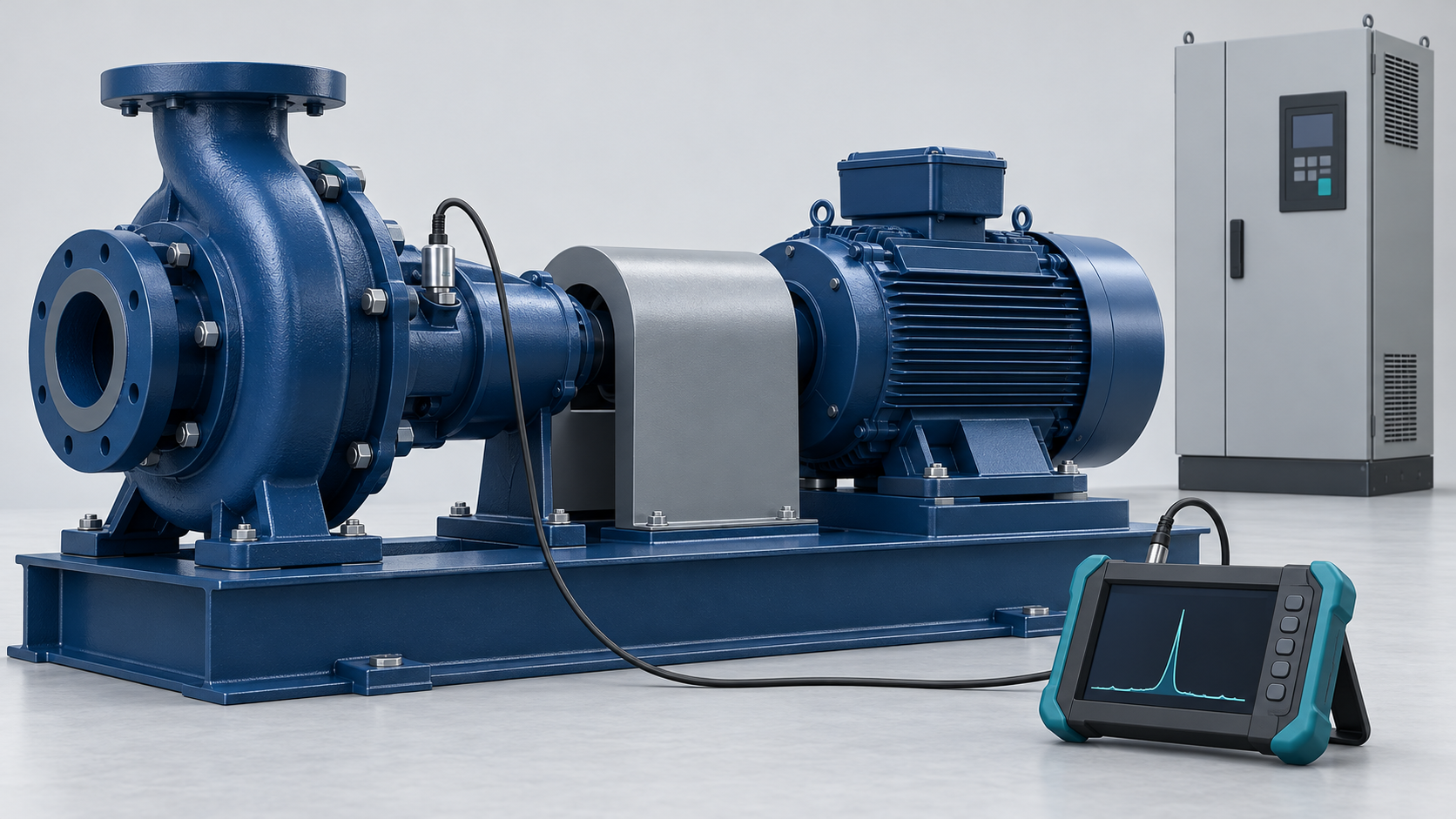
AI-generated concept illustration. The equipment and unscaled signal are illustrative, not a YSM product photograph, measured vibration spectrum or installation drawing.
KSB describes critical speed as a speed at which dynamic forces excite a component’s natural frequency and may produce resonance throughout the pump set. That explains why a machine can run smoothly on either side of a rough interval. KSB, Critical speed, undated; accessed November 1, 2026
Start with the operating record
The original Reddit question describes exactly this pattern: acceptable operation above and below a particular frequency. It asks whether the cause is resonance, controls or something inside the pump. The discussion supplies a useful symptom, but no instrumented diagnosis. Original question, October 22, 2026
Before commissioning another test, assemble the information a vibration specialist and pump supplier would need:
- Pump model, impeller diameter, motor details and drive model.
- Actual shaft speed and drive output frequency when vibration appears.
- Vibration measurement location, direction, units and instrument settings.
- Flow, suction pressure, discharge pressure and liquid temperature at the same time.
- Recent changes to alignment, foundations, pipework, impeller, bearings or drive settings.
As an editorial recommendation, use one record sheet for these readings so observations can be compared under the same conditions. “Bad at 40 Hz” is much less useful than a repeatable measurement with the operating state attached.
Compare the possible causes before choosing a correction
The table below is a diagnostic planning aid. Its observations guide further investigation; none independently identifies a failed component.
| Observed pattern | Investigation to request | Why it matters |
|---|---|---|
| A sharp, repeatable vibration peak over a small speed interval | Frequency spectrum, phase measurements and structural or rotor analysis as appropriate | Check whether an excitation coincides with a natural frequency |
| Vibration changes substantially with flow or suction conditions | Simultaneous hydraulic and vibration measurements | Check whether the disturbance is associated with the liquid flow |
| Symptoms began after mechanical work | Alignment, assembly, supports and component inspection against the relevant instructions | Establish what changed before specifying replacement parts |
| Actual speed or pressure oscillates rather than settling | Drive logs and review of the control loop | Determine whether the reported speed band is accompanied by unstable control |
The hydraulic alternative deserves attention. A pump operated away from its design condition may develop flow separation, recirculation, noise and vibration. Changing speed changes the hydraulic operating condition as well as the mechanical excitation. KSB, Operating behaviour, undated; accessed November 1, 2026
What experimental data can—and cannot—establish
Luo and colleagues studied a centrifugal pump with a rated flow of 50 m³/h, rated head of 32 m, and rated speed of 2,900 rpm. One experiment varied flow with the discharge valve while holding speed constant. Another changed available suction conditions at fixed flow and speed. Tests were repeated three times.
The authors found that statistical features of vibration signals could indicate changes in flow stability and cavitation behaviour. This supports recording hydraulic conditions when investigating vibration. It does not establish a resonance speed, permissible vibration level or skip band for another pump. Luo et al., Sensors, June 9, 2020, Table 1, Section 3.3 and conclusions; open-access paper
These are published experimental data, not measurements from YSM equipment or the Reddit installation.
When skip frequency is useful
Skip frequency is useful when the approved operating arrangement can avoid a troublesome interval while still meeting process requirements. Schneider Electric’s ATV930 guidance gives an example of a 30 Hz skip setting with 1 Hz hysteresis, producing an excluded operating range of 29–31 Hz. The example demonstrates the function; it does not recommend those settings for every pump. Schneider Electric, published January 12, 2018; modified May 15, 2026
Before applying that approach, ask the responsible engineer to confirm:
- The measured interval and the reason for selecting its boundaries.
- How the particular drive handles references and acceleration through that interval.
- Whether the remaining speeds can maintain required flow and pressure.
- Whether transitions between available operating speeds cause unacceptable process behaviour.
- What measurements will demonstrate an acceptable result after the change.
If process demand requires sustained operation inside the excluded interval, skipping it leaves an unresolved duty requirement. Mechanical or system changes may need assessment instead. The correct choice follows from the measured cause and required duty, rather than from the existence of a drive parameter.
Use a controlled verification plan
Do not repeatedly dwell in severe vibration to see whether it clears. Have qualified personnel agree on allowable test conditions and stop limits from the equipment instructions and applicable assessment criteria before collecting further data.
A proposed verification sequence is:
- Review historical readings and recent maintenance records.
- Check the installation and instrumentation with the equipment safely isolated where required.
- Obtain a specialist-approved measurement plan for any speed-dependent investigation.
- Record speed, vibration and hydraulic data together under approved conditions.
- Apply the selected correction and repeat comparable measurements.
- Save the final settings, results and operating restrictions with the maintenance record.
This sequence is an editorial workflow, not an instruction to conduct an unrestricted speed sweep or change live drive parameters.
Where replacement-pump and parts review fits
If the investigation identifies a component or configuration problem, YSM’s Summit 2196 ANSI Pumps replacement offering and D Mark III series provide relevant product information for an engineering enquiry. Send the existing pump identification, component drawings or measurements, operating data and diagnostic findings.
Check the proposed shaft, impeller, bearing arrangement and installation against the actual pump. A series name or a new component does not establish that the measured vibration cause has been corrected. The Summit link leads to YSM’s non-OEM replacement offering.
The practical decision
For VFD pump vibration confined to a speed band, establish a measured explanation and an acceptable operating plan. Use skip frequency where the confirmed constraints and process duty permit it. Verify the result with comparable readings before treating the job as complete.
Sources and dates
- Reddit question, r/pumps: October 22, 2026, date from public search index; original title and body directly read November 1, 2026.
- KSB technical entries linked above: publication dates not stated; accessed November 1, 2026.
- Luo, Y., Han, Y., Yuan, S., Yuan, J.: Research on the Single-Value Indicators for Centrifugal Pump Based on Vibration Signals, Sensors 20(11), 3283, June 9, 2020.
- Schneider Electric FAQ FA320875: published January 12, 2018, modified May 15, 2026; accessed November 1, 2026.
- YSM product links checked November 1, 2026. No service-specific performance or compatibility guarantee is made in this article.