
Chemical and wastewater pump selection guide
Pumps for Harsh Chemical Environments: How to Specify One
Reader question: “Anyone have any good recommendations on pumps that can take REALLY harsh environments?”
“Harsh” is not a pump specification. Define the complete liquid, solids, hydraulic duty, operating method and hazard boundary before selecting materials, seals or even the pump category.
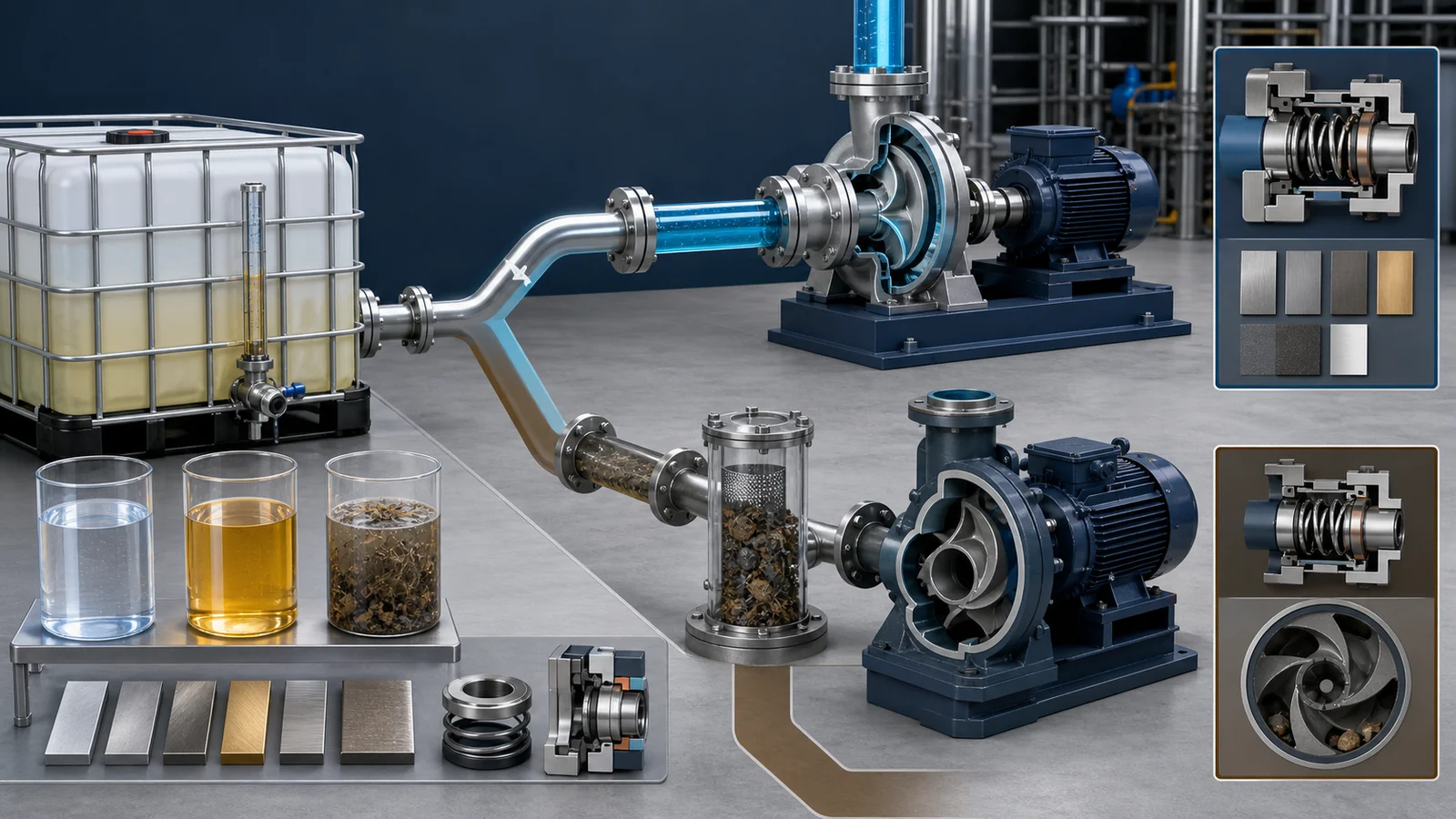
Application boundary
Choose the pump category before choosing the alloy
The same pH can describe very different physical and chemical services. The complete stream decides the route.
ANSI process-pump review may fit
- Liquid composition and concentration are defined
- Temperature and contaminants are controlled
- Solids and passages can be verified
- Material and seal evidence can be reviewed
BOUNDARY
Dedicated solids handling is more likely
- Rags, grit or large solids control the duty
- Waste composition changes without analysis
- Thick sludge or severe settling is present
- These pump categories are not supplied by YSM
Short answer: there is no universal “harsh-environment pump.” First determine whether the service is a characterized chemical-process liquid or changing wastewater containing solids, grit and unknown mixtures. Those duties may require entirely different pump designs.
The original Reddit question published on July 9, 2026 described wastewater containing lye, degreaser and phosphoric acid, with pH sometimes falling to 1. Low-cost submersible pumps were repeatedly failing during temporary IBC transfer.
Replacing them with a more expensive pump selected from pH alone would repeat the same selection mistake. This guide explains the evidence required; it does not recommend a material or pump for the unpublished mixture.
Why pH Is Not Enough to Select a Pump
A pH value does not identify:
- The chemicals present and their concentrations
- Chloride, fluoride, oxidizers or other contaminants
- Minimum, normal and maximum temperature
- Density, viscosity and vapor pressure
- Dissolved or entrained gas
- Suspended solids, particle size and fibrous material
- How the mixture changes between tanker loads
- The suitability of every wetted metal, elastomer, gasket and seal face
The ASME B73 centrifugal-pump data sheet requests temperature, specific gravity, vapor pressure, viscosity, pH, chloride concentration, corrosion or erosion risk, solids percentage and maximum particle size separately. See ASME B73 data sheet, November 2019.
Real Corrosion Data Shows Why Conditions Matter
A laboratory study tested Types 304 and 316 stainless steel in 85% phosphoric acid at 80°C, 100°C, 113°C and 130°C. Type 304 showed critical corrosion behavior around 105–107°C. The result cannot be transferred directly to mixed wastewater, but it demonstrates why “phosphoric acid” and “stainless steel” are not sufficient specifications. See Lizlovs, September 1, 1969.
Another study examined an industrial phosphoric-acid environment containing sulfuric acid, gypsum slurry and fluoride. Corrosion in the settled slurry was more severe than in the mixed-acid solution without the slurry. Impurities and solids changed the material environment. See The Society of Materials Science, Japan, 1993.
ASTM G31 therefore requires corrosion tests to record variables including solution composition, temperature, gas sparging, fluid motion and exposure duration. It also warns that accelerated tests may give only indicative—or misleading—results. See ASTM G31-21, reapproved 2025.
First Decide What Is Actually Being Pumped
| Actual service | Likely equipment direction | YSM supply position |
|---|---|---|
| Characterized acid or alkali solution with controlled solids | Chemical process pump may be considered | G196 or D Mark III can be reviewed |
| Raw wastewater containing rags, grit or large solids | Non-clog or solids-handling wastewater pump | Not supplied by YSM |
| Thick sludge or concentrated slurry | Purpose-designed sludge or slurry pump | Not supplied by YSM |
| Temporary transfer with changing liquid level or dry-running risk | Transfer system selected for the operating method | Separate equipment-category review required |
| Unknown or changing chemical mixture | No final selection before sampling and hazard review | Technical evidence required |
EPA guidance states that raw wastewater requires solids-handling capability and identifies dedicated wastewater pump categories. See U.S. EPA, 1980. EPA guidance also notes that large solids and grit can cause clogging, mechanical wear and increased maintenance, which is why screening and grit removal protect downstream equipment. See U.S. EPA, September 2003.
Why the Existing Pumps May Be Failing
- Wetted-material incompatibility. Casing, impeller, shaft, fasteners and other components may respond differently.
- Seal or elastomer incompatibility. A suitable metal casing does not prove that O-rings, gaskets and the shaft-sealing arrangement are suitable.
- Solids and stringy material. Grit can cause erosion, while fibres and debris can obstruct passages.
- Incorrect hydraulic duty. A pump selected without total head and system-curve data may operate outside its intended range.
- Changing temperature. Temperature affects corrosion behavior, viscosity, vapor pressure, sealing and NPSH.
- Air ingestion or poor submergence. Temporary IBC arrangements can ingest air or form vortices.
- Operating method. Frequent starts, intermittent emptying and possible dry running must be included in the specification.
The sodium hydroxide and phosphoric acid mentioned in the question are worker hazards as well as equipment-selection variables. NIOSH describes sodium hydroxide as caustic and capable of causing tissue burns. See NIOSH sodium hydroxide guidance, accessed July 18, 2026. Site procedures, SDS information and a job-specific hazard review remain necessary.
Selection Information Required
Liquid data
- Full chemical names and concentration ranges
- How different tanker loads are sampled and mixed
- Minimum, normal and maximum temperature
- pH range and important contaminants
- Density, viscosity and vapor pressure
- Solids by weight or volume and maximum particle size
- Fibrous material, settling behavior and entrained gas
- Available SDS and laboratory analysis
Hydraulic data
- Minimum, normal and maximum flow
- Source and destination liquid levels and pressures
- Pipe material, internal diameter, length, valves and fittings
- Required discharge pressure and suction arrangement
- NPSHA, operating hours and starts per day
Mechanical and site data
- Indoor or outdoor location and area classification
- Motor voltage and frequency
- Mounting and leakage requirements
- Cleaning, flushing and decontamination method
- Standby capacity and maintenance access
How to Verify Materials
- Identify the complete liquid composition and operating envelope.
- List every wetted component, including elastomers and seal faces.
- Use compatibility charts only for preliminary screening.
- Obtain written recommendations for the stated conditions.
- Where consequences justify it, perform representative coupon or immersion testing.
- Record composition, concentration, temperature, contaminants, motion and exposure duration.
- Review localized corrosion, erosion and stress-corrosion risks separately where applicable.
A material name should not be published as “compatible” until the exact service conditions and supporting evidence have been reviewed.
When YSM Process Pumps May Be Relevant
If the liquid is sufficiently characterized, the solids are within a reviewed process-pump boundary and the service is chemical processing rather than raw-wastewater handling, YSM can review the G196 ANSI process-pump family or the D Mark III ANSI process-pump family.
The material, seal chamber and exact pump size still require application review. Neither family should be described as universally suitable for pH 1 wastewater, mixed tanker waste, grit, sludge or unknown chemical combinations.
Common Selection Mistakes
- Selecting from pH alone
- Assuming all stainless steels behave alike
- Checking the casing but ignoring elastomers and seals
- Ignoring impurities, grit and fibrous solids
- Using a chemical-resistance chart as a performance guarantee
- Treating raw wastewater as a clean chemical solution
- Buying a larger pump without calculating the system curve
- Replacing a failed pump without inspecting the failure mode
Sources and Dates
- Original Reddit question — July 9, 2026
- ASME B73 pump data sheet — November 2019
- ASTM G31 corrosion-test guide — G31-21, reapproved 2025
- Lizlovs phosphoric-acid corrosion experiment — September 1, 1969
- Industrial phosphoric-acid corrosion study — 1993
- EPA wastewater pump-selection guidance — 1980
- EPA screening and grit-removal guidance — September 2003
Related Technical Guides
Wastewater Chemical Transfer Pumps
Use the application boundary to separate controlled treatment chemicals from raw wastewater and sludge.
Review the application routeChemical Pump Material Selection Inputs
Prepare the composition, temperature, contaminants and wetted-component evidence before selecting materials.
Open the material checklistNeed a Pump-Type and Material Review?
Send the laboratory analysis, SDS information, solids data, transfer method, hydraulic duty and photographs of the failed pump. YSM will first confirm whether the service belongs within its ANSI process-pump scope.