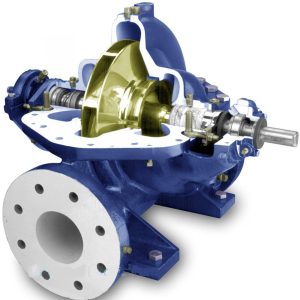
ANSI/ASME B73.1 · Open Impeller
G196 Series
Open-impeller process pumps in STX, MTX, LTX and XLTX frames, supported by size, material and replacement-part data.

Industrial Process Pump Portfolio
Explore ANSI B73.1 chemical process pumps, heavy-duty process pumps, self-priming models and replacement-part support. Start with the pump family or duty requirement, then send the operating data for configuration review.
Family positions and counts summarise the published series and model pages. Size-specific limits, materials and sealing are confirmed during engineering review.

Compare the verified family position first, then open the series page for sizes, construction information, technical boundaries and the appropriate model page. The family decides more than hydraulics: it fixes the impeller philosophy, the power-end or frame grouping and the replacement-part logic an installation will live with for decades.
ANSI/ASME B73.1 · Open Impeller
Open-impeller process pumps in STX, MTX, LTX and XLTX frames, supported by size, material and replacement-part data.
ANSI/ASME B73.1 · Reverse Vane
Reverse-vane process-pump family with Group 1, 2 and 3 configurations, including general-purpose and low-flow review paths.
Paper Stock · Heavy-Duty Review
Process-pump family positioned for paper-stock and heavy-duty service. Current source data is primarily dimensional.
Use the operating requirement to narrow the first review. A duty-led start changes the door, not the discipline: final selection still requires the complete flow, head, liquid, suction and construction data.
For a broad range of chemical and industrial process duties — the default entry when no dedicated hydraulic constraint applies. Both ANSI families publish a general-purpose model: the G196 general-purpose pump and the D Mark III general-purpose pump.
For duty points that would sit far left of best efficiency on a general-purpose size. Both ANSI families carry dedicated low-flow sizes, reached from their series pages. Review low-flow selection →
For applications where suction layout and priming behavior are key selection inputs. Two reviewed models are published: the 3796 self-priming process pump and the unitized self-priming process pump.
This table identifies the appropriate starting page. It is not a substitute for a reviewed, size-specific pump selection.
| Product family | Standard / position | Impeller / grouping | Best starting point |
|---|---|---|---|
| G196 | ANSI/ASME B73.1 process pump | Open impeller; STX/MTX/LTX/XLTX | Complete pump, wet end or replacement-part review |
| D Mark III | ANSI/ASME B73.1 process pump | Reverse vane; Group 1/2/3 | General-purpose or low-flow selection |
| G 3175/3180/3185 | Paper-stock / heavy-duty process | S/M/L/XL dimensional groups | Large-size and heavy-duty duty review |
Series-level coverage, materials and technical boundaries are stated on each family page.
Available wet-end materials may include WCB, CF8M (316 stainless steel), CD4MCu, CN7M / Alloy 20, Monel, Nickel, Hastelloy B or C, Titanium and Zirconium alloy. Availability varies by component, configuration and family. The reason this page maps no liquid names to alloys is that concentration, temperature, impurities and aeration flip the answer — the same acid name can be pumped in steel at one strength and demand an exotic alloy at another. Send the liquid data, not just the liquid name, and prepare the material-selection inputs before the enquiry.
A material name alone is not a compatibility recommendation. Final selection requires liquid composition, concentration, temperature, pressure, solids and corrosion data.
Showing the single result